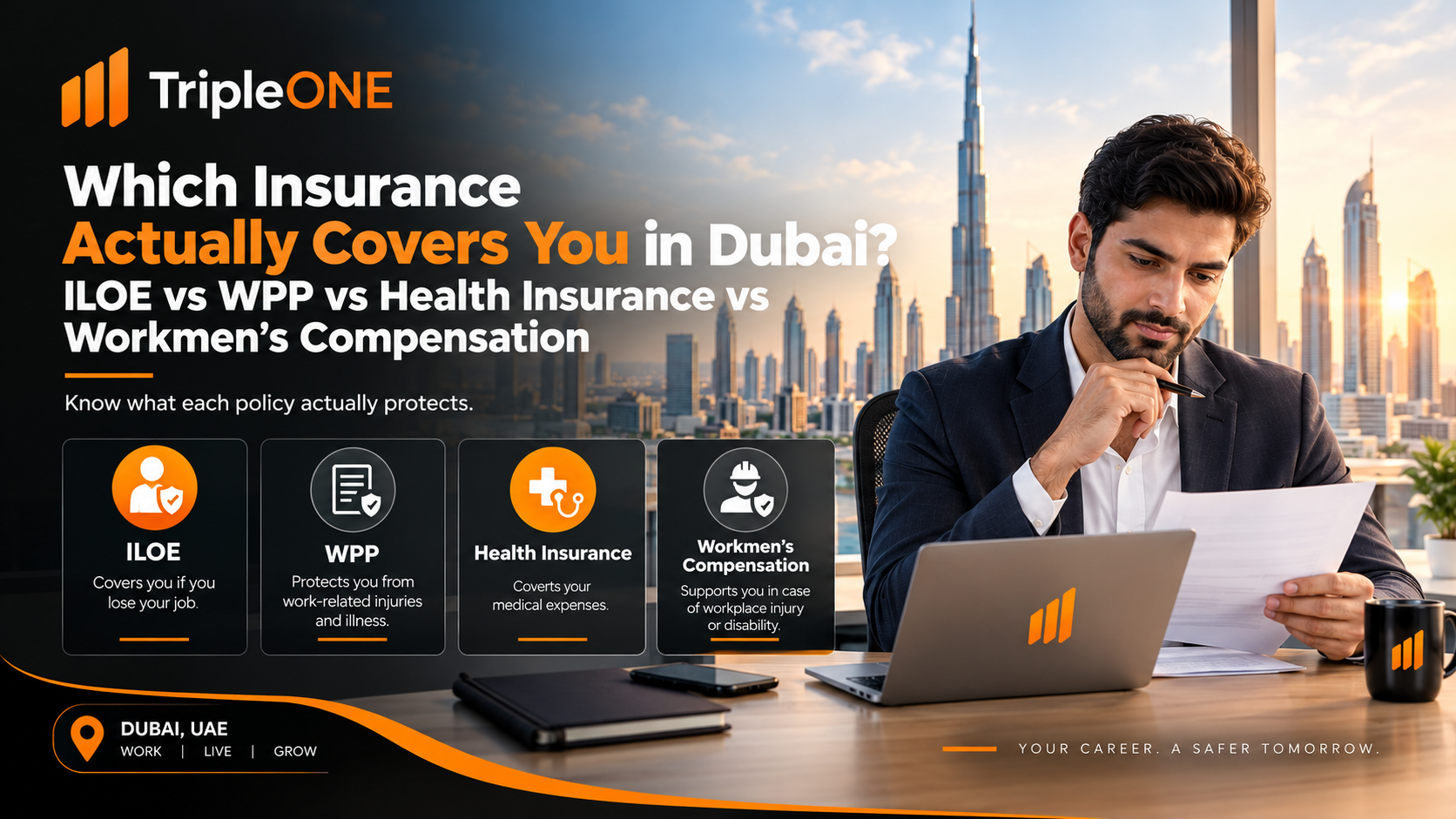
Ask ten employees in Dubai what ILOE stands for, or how it's different from workmen's compensation, and most will guess wrong or simply shrug. That confusion is understandable. All four of these insurance types sit under the umbrella of employee protection, all four are legally required in some form, and all four show up in onboarding paperwork nobody reads closely. But they cover completely different situations, are paid for by different parties, and pay out under completely different circumstances. Knowing the difference matters, because if the wrong situation happens to you, and you don't know which policy actually applies, you could miss a claim window or assume you're protected when you are not.
Quick Comparison
● ILOE Insurance: paid by the employee, replaces part of your income if you are made redundant or terminated without cause
● Workers Protection Insurance (WPP): paid by the employer, pays out unpaid wages, gratuity and repatriation if the employer defaults or goes insolvent
● Health Insurance: paid by the employer, covers everyday medical care, doctor visits, hospital stays and medicines
● Workmen's Compensation Insurance: paid by the employer, covers the employer's legal liability for injury, disability or death caused by a workplace accident
ILOE Insurance: Your Safety Net If You Lose Your Job, Not If You Quit
ILOE, short for Involuntary Loss of Employment insurance, is the UAE's mandatory unemployment insurance scheme, established under Federal Decree-Law No. 13 of 2022 and in effect since 1 January 2023. It is one of the few insurance types on this list that the employee pays for directly, though the premium is deliberately kept small.
● Who pays: the employee, through a monthly subscription via the ILOE app, the official ILOE website, or approved service centers
● Premium: Category A, for basic salaries of AED 16,000 or below, costs AED 5 per month plus VAT. Category B, for basic salaries above AED 16,000, costs AED 10 per month plus VAT
● Eligibility: you must have paid at least 12 consecutive months of premiums before you are allowed to make a claim
● Pay-out: up to 60% of your average basic salary over the previous six months, capped at AED 10,000 per month for Category A and AED 20,000 per month for Category B, paid for a maximum of three consecutive months per claim
● What disqualifies a claim: resignation, termination for disciplinary reasons, or a fraudulent claim. ILOE only responds to involuntary termination, such as redundancy or company closure
● Claim window: you must file within 30 days of the termination date, and there is no grace period for late filing
● Non-compliance: missing your subscription or letting premiums lapse can result in a fine, generally cited in the AED 400 to AED 600 range, and unresolved liabilities can affect work permit and visa renewal transactions
Workers Protection Insurance (WPP): What Happens If Your Employer Can't Pay You
Workers Protection Insurance, run through MOHRE's Workers Protection Program, exists for a very different scenario: not job loss, but employer default. It was introduced to replace the old system where employers had to lodge a bank guarantee of at least AED 3,000 for every worker, a rule that tied up significant cash, particularly for smaller companies.
● Who pays: the employer, as a periodic insurance premium instead of a bank guarantee
● What it protects against: the employer being unable or unwilling to meet its financial obligations, due to insolvency, bankruptcy, or simply refusing to pay
● What it covers: unpaid wages, unpaid end-of-service gratuity, and repatriation or flight costs back to the employee's home country
● Coverage limit: compensation is generally capped at up to AED 20,000 per worker, though the exact figure depends on the specific package the employer has subscribed to, as MOHRE offers more than one insurance package under this scheme
● When it triggers: a claim is processed once MOHRE, or a Labour court, has confirmed that the employer has failed to meet its obligations. It is not something an employee applies for speculatively
● Mandatory status: private sector employers must secure either a bank guarantee or a WPP policy before a work permit is issued for a new employee
Mandatory Health Insurance in Dubai: What Every Employer Must Provide
Health insurance in Dubai has been mandatory since the Dubai Health Insurance Law, DHA Law No. 11 of 2013, and the requirement has since been extended nationally, with mandatory employer-provided health cover now enforced across all seven emirates from 1 January 2025. Unlike ILOE, this one is entirely on the employer's shoulders.
● Who pays: the employer is legally required to provide and fully fund health insurance for every employee, and cannot deduct the premium from the employee's salary
● Minimum standard in Dubai: the DHA Essential Benefits Plan (EBP) is the legal minimum for employees earning AED 4,000 per month or less, with an annual claim limit of AED 150,000
● What it covers: outpatient doctor consultations, prescribed medication, emergency treatment, diagnostics, hospitalization, and maternity care after a waiting period, generally through a defined network of approved hospitals and clinics
● Visa dependency: residency visa issuance and renewal is blocked without proof of active, valid health insurance, since immigration authorities verify coverage at every visa transaction
● Cost: EBP-level premiums in Dubai typically start in the range of a few hundred dirhams and can run higher depending on the insurer and plan tier, while the lowest-cost standardized basic package introduced for the Northern Emirates sits at a lower price point again. Employers wanting broader coverage for staff typically move to a higher tier plan above the legal minimum
Workmen's Compensation Insurance: Coverage for Workplace Accidents and Injuries
Workmen's Compensation Insurance addresses a scenario the other three don't touch at all: what happens when someone is actually hurt on the job. It is grounded in the UAE's Labour Law framework, most recently Federal Decree-Law No. 33 of 2021 on the Regulation of Labour Relations, which places strict liability on employers for workplace injuries, occupational illness, and death, regardless of fault.
● Who pays: the employer, and in most UAE free zones this policy is also a specific condition for trade license renewal
● What it covers: medical treatment costs, wage replacement during recovery, lump-sum compensation for permanent disability, and death benefits paid to dependents
● Trigger: the coverage applies specifically to accidents, injuries, or occupational illness arising out of and during the course of employment. It is a liability-based policy tied to the employer's legal obligation, not a general benefit like health insurance
● What it does not cover: injuries caused by an employee's deliberate self-harm, intoxication, or willful breach of clearly established safety procedures
● How it differs from health insurance: health insurance pays for everyday medical care regardless of cause. Workmen's compensation exists specifically to cover the employer's legal liability when a workplace incident causes the harm, and the two are meant to work alongside each other rather than replace one another
How These Four Insurance Types Work Together
These policies are not competing with each other. They are designed to click into place at different moments of the same employment relationship, and understanding the sequence makes the whole system much easier to follow.
Picture a warehouse worker in Dubai who slips and injures his shoulder on shift. His employer's health insurance covers the initial hospital visit and diagnostics. Because the injury happened on the job, workmen's compensation insurance is what actually pays his ongoing medical treatment, his wages during recovery, and would cover disability compensation if the injury turned out to be permanent. Now imagine that a few months later, the company runs into financial trouble and closes down without paying his final month's salary or his end-of-service gratuity. That is where Workers Protection Insurance steps in, since it exists specifically to cover employees when an employer defaults. Finally, because the company closure means he has lost his job through no fault of his own, he can file an ILOE claim, provided he has been subscribed for at least 12 months, and receive up to 60% of his basic salary for up to three months while he searches for his next role.
Four different policies, four different payers, four different triggers, and in a worst-case scenario, all four can genuinely apply to the same person within the same year.
Frequently Asked Questions
Q: Do I have to pay for my own health insurance in Dubai?
A: No. Under Dubai Health Authority regulations, your employer is legally required to provide and fully fund your health insurance, and is not permitted to deduct the cost from your salary.
Q: Can I claim ILOE if I resign from my job?
A: No. ILOE only pays out for involuntary termination, such as redundancy or a non-disciplinary dismissal. Resignations and terminations for misconduct do not qualify for a claim.
Q: What if I'm not sure whether my employer has enrolled me in Workers Protection Insurance?
A: WPP enrolment is required before a work permit is issued, so most employees are automatically covered. If you suspect your employer has not paid your wages and may not be compliant, you can raise the matter through MOHRE to verify your coverage and file a complaint if needed.
Q: Does workmen's compensation replace the need for health insurance?
A: No. Workmen's compensation only responds to injuries or illness caused specifically by a workplace accident, and covers the employer's legal liability in that situation. Health insurance covers your general medical care regardless of cause. UAE law requires employers to maintain both.
Conclusion
None of these four policies are optional extras. Each one is a legal requirement in the UAE, and each one protects you in a scenario the others simply don't cover. The most useful thing you can do as an employee is know which one applies before you actually need it, whether that means checking your ILOE subscription status, confirming your health insurance card is active, or understanding what happens if your employer runs into financial trouble. If you are currently comparing job offers across the UAE, it's worth asking any prospective employer directly how each of these is handled, since a company that manages this properly is usually a good early signal of how it treats its people more broadly. Browse verified openings from compliant, licensed employers on TripleONE Jobs.
References
● Federal Decree-Law No. 13 of 2022 on Unemployment Insurance (establishes the ILOE scheme)
● Cabinet Resolution No. 97 of 2022 and Ministerial Decision No. 604 of 2022 (ILOE implementation rules)
● Cabinet Decision No. 318 of 2022 concerning Bank Guarantees and the Employees Protection Insurance Scheme (WPP)
● Dubai Health Insurance Law No. 11 of 2013, Dubai Health Authority (DHA)
● Federal Decree-Law No. 33 of 2021 on the Regulation of Labour Relations (UAE Labour Law, employer liability for workplace injury)
● Official UAE Government Portal, u.ae, and the Ministry of Human Resources and Emiratisation (MOHRE)